29 March 2010

The circular nature of things

I never cease to be amazed at the cyclical nature of life. Between birth and the inevitable but largely-feared thing we call death, our lives move in circles much the way our earth moves around the sun to give us the seasons by which we mark off spent years. It’s a good thing we move in circles, I say. This way when we find a place that is special or a friend who is dear, we can return for another look or share another day. Just think how odd it would be to always move straight ahead, never being able to make a go-round, never being able to get one more taste of something surprising and sweet. I’m not interested in a route through life that never brings me back again or gives me another shot at something I’m good or bad at.

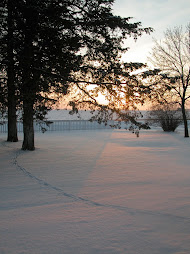
One month ago I wrote this post about the closing of February, the end of what was, by all accounts here at our farm, a hard winter. I brought my camera to document my morning walk to the wood pile and the photos I brought inside showed a stark but beautiful landscape encrusted in ice. One month later, the scene has been redrawn in gold and green and blue. Spring has arrived both on the calendar and on the farm. Spring has done more than arrived. It has returned! And isn’t that a better way to look at it?

One month ago I looked across the expanse of frozen water and couldn’t discern the far edge of the lake. Throughout today, though, I have watched the ice retreat from one edge of the lake to the other. Tonight, I enjoyed my first sunset over glistening waves, my first sunset, that is, of this year. I looked forward to it all weekend as I watched the darkening ice break at the edges then in parts of the lake’s center. Saturday, I watched Canada geese land on the surface, break through and then struggle to get airborne as the surface gave way beneath their weight. I knew today was going to be ice out day. I’d seen it happen before. Ice out is just one notch on the life cycle that envelops me here. It’s a day worth celebrating as much as — if not more than — those days that commemorate presidents or statesmen or lovers.

I look forward to dozens more ice out days and sunsets over glistening waves as the seasons continue to cycle. I will watch migrating birds fly north and then south and then north again. My trees, now spattered with tiny buds will soon burst with blossoms and then leaves and, eventually color. And then they will stand naked against the frozen sky. My heart, watching our seasons cycle past, will fill with hope, and then joy, and then dread, and then hope once again.

I can even note the change in the stacks of wood. The split and dried wood is mostly gone, burnt to keep our fuel costs low and my fingers warm. Next year’s fuel is piled not so neatly yet in place to absorb the wind and heat that will give us an autumn chore of splitting and stacking. Autumn. Its arrival is as inevitable as the Canada goose taking a break from migration on my shore. I will not lament it because it’s part of the cycle.

One month ago, winter held our farm, and me, in a firm and icy grip. I’m glad life moves in circles. Spring is here now. I don't look for my boots anymore. Tonight’s walk to the shore was made in my slippers!

01 March 2010

Book with universal themes is classic

I just finished reading “Emily of Deep Valley,” juvenile fiction written in 1950 by Maud Hart Lovelace. I have written about Hart Lovelace here before; she was a native of Mankato and based most of her juvenile fiction on experiences she had in the small but picturesque town that is but a short carriage ride from here.

I didn’t grow up a fan of Hart Lovelace books. To be honest, before moving here, I’d never heard of her. (My summer reading lists were filled with Agatha Christie mysteries, all of them on short loan from the St. Paul Public Library.) As I build my network in and around Deep Valley, I’ve met lots of Hart Lovelace devotees who like me hadn’t found her Betsy Tacy series or her high school books when they were young. They did, however, discover the books after they had had daughters of their own. With her characters unwrapped in the midst of mother-child bonding, I can see how the author can command such a loyal following with clubs and societies around the world charged with keeping her work available and her memory alive.

But what appeal can books written 60 years ago and set 100 years ago have for twenty-first century, text-messaging pre-teens who could just as easily flip on television for entertainment? How can Hart Lovelace remain as relevant in theme and plot in 2010 as she was during the Eisenhower administration? It was that question that led me to pick up and read “Emily of Deep Valley,” which is set in 1912 as Emily graduates from Deep Valley High. (Trust me dear ones, I don’t have many juvenile fiction titles in my home library and St. Paul Public is a long carriage ride from here.)

As it turns out, a girl in high school in 1912 suffered from the same sort of social challenges and self-doubt as girls in my grade had and, I suspect, as do girls in school today. “Do I fit in?” “Are my clothes fashionable?” “Am I smart enough?” “What am I supposed to do with my life?” And, of course, “does that boy I’m in love with even know I’m alive?” The more the world changes, the more the world stays … .

But Hart Lovelace goes deeper with her character in the book; she takes Emily face first into social issues of her time, social issues faced by the citizens of the real Deep Valley, and this is where Hart Lovelace snags me as a lifelong devotee even though I don’t have the advantage of sharing her work with an offspring.

Emily befriends a few children who belong to the town’s immigrant community: the Syrians. Her friendship leads to new introductions, discoveries and an education about a people with a rich culture; people, she learns, who have been largely shunned and marginalized by her community. Emily is able to find peace with herself when she turns her attention away from her worries about her looks and her future; her self image grows by leaps and bounds when she throws herself into helping others. That theme alone is a winner. It’s basically the call of Christianity.

But for me, the story goes deeper. I have ancestors who were known around another river town as “the Syrians.” And like the Syrians in Hart Lovelace’s book, my family was marginalized, called names by the “better” citizens of their town. Their immigration was not welcomed by those who felt the United States had enough people. They struggled with language and social structures and yet lived full lives in “shabby houses that needed paint.” I like to think that someone like Emily might have wandered into my ancestors’ neighborhood, into my ancestors’ lives, to extend to them some version of Emily’s small-town spirit of friendship. And why not? Hart Lovelace’s fiction is based on her early life experiences. Her stories are authentic. Her stories are timeless.

It is 2010 and the immigrants living on the fringe of our communities in shabby abodes hail from a different part of the world than Ottoman-controlled Syria. Yet, I’ll bet they hear people whisper derogatory names when they pass. I’ll bet some people feel they don’t belong here; the country is full enough. Still, I’d bet my carriage that despite the majority’s indifference to them, they are living out rich traditions and full lives in the shadow of the American dream like my ancestors once did. And I’ll bet somewhere in America there’s a teenager who, because of the example set by the fictional Emily Webster, is confident enough to step forward make a difference in their lives.

And so I’ve found the answer to my question. Maud Hart Lovelace remains relevant long after her death. We should all be so fortunate.

26 February 2010

A cold morning's routine inspires

At Four Cedars, my February ends much like it began. I make a cold morning's walk to the woodpile, marveling with each step at how beautiful and complex a barren landscape can appear when one is fortunate enough to take note. I am a lucky soul this morning to have so much to take in around me. The blue sky. The hoar frost. The deep snow pack showing evidence of scampering wildlife. The expanse of frozen water disappearing in the fog. And yes, the optimistic chirping of a nearby robin. It is the end of February, it reminds me. We have made it to the other side of winter, you and I. It may not be the warmer side, but surely it is the brighter side. Chirp. Chirp.

The TV weather person said today is our 80th day of snow pack. We haven't enjoyed much melting around here; it seems there aren't enough trees and buildings in these parts to absorb solar energy from our strengthening sun. And so our temps lag behind those enjoyed by our urban brethren. This seems a small trade-off today. I know the temperature is below zero and I must collect my wood, and yet I linger with my camera and my thoughts. It feels good to be part of the expanse, free from the oftentimes confining walls of a heated abode.

When busyness allows, I'll be keeping my eyes on the channel above, looking for signs of melting. Two months from now, this will be a bustling place with red and yellow winged blackbirds singing Spring's praises while mud hens chatter like old women at a hairdresser's shop. The rushes will change color, from tan to yellow to green and ultimately auburn. The wind will make the marsh dance. And I'll stop here to watch and listen as often as possible, for this is the view that lured me to this place nearly four years ago. This view. The stage for glorious sunsets. The balcony at nature's nightly operetta.

At the corner of my vision I notice the hoar frost has saturated the ends of my hair. My desire to linger among the ice-coated limbs of the barren trees wanes as the cold penetrates my flesh. There is wood to retrieve and a home to warm this morning. I decide I will return to lake's edge later in the day when the sun is a greater ally against the chill. I bid the robin farewell. We shall meet again soon, my friend. We have both made it to better side of winter with our optimism intact.

07 February 2010

Walking on water (sort of)

The snowshoes arrived and the pruning continues.

Winter (dormant) pruning is not for the faint of heart for several reasons: walking in snow shoes raises the heart rate; it's still pretty cold outside; and the deep snow requires plenty of bending. But mostly, pruning requires courage because once the snip is made there's no turning back, no Undo button to click on, no history to delete.

That's me enjoying an afternoon outdoors not standing knee-deep in snow.
Remember when Andre Agassi had long blond locks? Then suddenly he was bald. Exactly!

17 January 2010

Sometimes all it takes is a windless day...

People unfamiliar with grape growing are often surprised to learn that there is much work to be done in the vineyard in what they'd presumed to be our "off-season." The bulk of the work falls under the category of pruning, but it is far different from the pruning we do in late spring and early summer. In winter, we are assigned the task of dormant pruning, a critical task that affects the quality of the harvest we hope to enjoy about nine months from now.

There is a formula one can follow to determine how to prune (30 buds left behind per pound of wood removed) but simply put, we leave as many buds as we think our plants can effectively ripen next season and remove the remainder of last season's growth. As you can see from the photo above, that's a lot of wood to be cut, hauled out of the vineyard, and burned.

Cutting is something we've gotten quite proficient at here as we approach our third growing season. And we've even got quite adept at gauging optimum pruning weather. Hint: we ignore the forecast and walk outside. If the temperature exceeds 20 degrees and there's no wind, we prune.
This winter, though, we've been challenged by excessively deep snow. A walk down one row is currently an extreme cardio workout, so much so that we've adopted a new pruning strategy.
Now, we trudge down the rows, pruner in hand trying not to get stuck or tip over, make our critical cuts, and leave all the wood hanging in the trellis. (It's not going anywhere).
This is all we can manage in knee-deep snow. This way, we can be assured of getting the work done that absolutely needs to get done. When the snow melts to more modest levels, sometime between next week and May, we can get back down the pruned rows to clean the wood out of the trellis.

My children urged me to invest in snow shoes to ease the process. I hedged at first. Then my son reminded me that this probably won't be the only winter I'll prune in deep snow. The snow shoes are in transit.

08 January 2010

Who does this?

Months ago, I vowed to stop blogging about the weather. I mean, what is the point of complaining, worrying, writing, or groaning about something of which we have no control. The weather happens whether we like it or not. The only thing we can control about weather is if we decide to stick around and put up with it or not. Some of us not only decide to stay, we invest ourselves in putting up with a future of winters by planting a vineyard. Some of us need to get our heads examined!

29 December 2009

What is a picture worth?

Words are things and a small drop, if ink falling like dew upon a thought, produces that which makes thousands, perhaps millions, think. Lord Byron said that some 200 years ago. Today we have Oprah's book club and publishers who seek out non-writers (like Howie Mandel) so that they may convert television fame into book sales. What's a writer to make of these developments? More importantly, how is a writer to soldier on against such odds? Tonight, let's chalk it up to insanity and move on.

The sun disappeared into the barren, frozen cornfield some seven hours ago and yet here I sit tapping the keys of my computer -- writing, engaging myself in what I believe to be a noble vocation. Except it doesn't feel noble at the moment. It just feels like I'm driving at night without headlights and no one should do that, not even professional drivers on a closed course. I am attempting to communicate a thought that hasn't taken form. Or, maybe, I'm attempting to communicate a thought that rubs me the wrong way. Regardless, the [digital] ink isn't going to fall like dew to give anyone pause. And this too is the writing life, the insanity. Frustration equals writing. No. Writing equals frustration. At least it does tonight.

I know what my problem is and it isn't fatigue...isn't solely fatigue. It's these things that I bet my future on -- these words that wield so much power and potential to move people or change minds or spur reflection -- tonight they pale so completely when compared to the power of the printed image. What's a picture worth? A thousand words? How about 65,000 words? That's roughly a book-length work.

If you believe, like me, that writing is a noble craft, you engage it until your hands and your heart are soiled with words, which are beautiful, powerful, provacative things. Beware. Don't believe, like me, that nothing can eclipse words in their ability to inspire, to transport us to a far off place or time long passed. Like me, a picture may fall into your hands to humble you, to make you question all you ever believed about words and their promises. This picture came to me two days ago and I hadn't known of its existence before receiving it. This picture is keeping me from a warm bed and silly dreams that I probably won't remember upon waking.

This woman is Ann, though her name is written as Anna on the back. Also on the back is a note that her hair is black, her eyes are brown, her beads are red and her dress is red and tan. Missing from the back is the date the photo was taken.

I have a picture of Ann taken ten years before this one, I have one of her taken roughly fifteen years after this one, and I have one taken of her when she looked like a grandmother -- my grandmother. Moreover, I have stories to go with those pictures, stories of young Ann, stories of single mom Ann, stories of senior citizen Ann. I have these stories because I wrote them; they are the core of a book I spent three years writing in an effort to honor Ann. But there's nothing in the book about a beauty with brown eyes and wavy bob. I cherish this newly emerged picture, but the thousand or so words that hide in the shadows behind her are a gaping hole in her story that now haunts me.

And so I'm left to ponder what is more powerful, the words or the image? Right now, I'll say it's the image because it's all I have. The words are hidden, perhaps forever.

10 December 2009

The calm after the storm...

It has been nearly 24 hours since the blizzard moved east leaving people in these parts to cope with the aftermath. For some, that meant taking their snow machines out for a spin; for me, that meant my first plowing run through the drifted snow around the property. Except for ten very cold fingers, the plowing was accomplished without incident.

The mercury in our outside thermometer barely broke zero today, which means I spent my non-plowing hours as close to the wood stove as I could get without stepping on the cat, who has claimed the edge of the rug closest to the flame. Smart cat. Smart me. We were meant to be together this winter.

These days of short sunlight don't do much to warm the atmosphere, but the milky light can be a tonic for the soul. Sunrise fills each dawn with fuschia and dusk bathes the sky in the dreamiest yellow one finds outside of sleep. It's a photographers wonderland outdoors this time of year. Or it would be if the camera didn't transfer the bitter cold right back to my ten frozen fingers. They just can't take this cold.

25 November 2009

Even tradition needs periodic change...

It is Thanksgiving eve as I write this and for the first time in 18 years, I am not putting the finishing touches on a dining table set for guests. I’m not rolling silverware in napkins. I’m not chopping veggies for stuffing or deciding which secret ingredient will give the dish this year’s twist. I’m not washing stemware or counting out place settings. I’m not searching for candles or printing out place cards. For the first time in 18 years, I’ve abdicated the Thanksgiving Day hostess throne. Tonight, I am ready to become a guest. It is time for Thanksgiving Day to become someone else’s signature holiday.

I remember adopting the holiday as my own when my sons were toddlers. Transporting twins anyplace, let alone a holiday place, meant packing the car full with diapers, bottles, toys, a playpen, portable booster seats, and at least three sets of extra outfits each. Whew! What a chore that was. Cooking a turkey, stuffing, vegetables and pies for a dozen or more had to be easier than that, I thought at the time. And for the most part, it has been.

I recall with fondness the trepidation I felt the first year. I had gone to antique stores to buy extra dishes in preparation and I carefully planned out seating strategies for up to twenty people in a house without a dining room. Those first few years, I even mailed invitations. This was before email. Yikes, it was probably even before the internet!

I love to entertain and Thanksgiving allowed me the opportunity to welcome many new faces into our home. Through the years, we offered hospitality to neighbors whose own families were far away. We welcomed widows who might otherwise be alone. We welcomed boyfriends who have since moved on, boyfriends who are still boyfriends and boyfriends who are now husbands. I recall with fondness welcoming a foreign exchange student (a friend of my nephew), a young woman from Russia who celebrated her first, and likely her last, American Thanksgiving with us. Her day was not one I expect her to forget and I chuckle even now by how delighted she was when she saw our six-inch paper dessert plates that had been printed in fall colors with a turkey in the center. She had never seen a paper plate like it and she asked if she could take one with her. I gladly obliged.

Of course, some of our Thanksgiving meals were larger than others and some, more stressful to pull off. There were a few years when, two hours before guests were scheduled to arrive, like clockwork, I suffered a ten-minute-long mental breakdown. Hubby was right there to talk me off the building’s edge and the rest of the day played out like a well-rehearsed symphony.

I would be remiss if I didn’t mention those Turkey Bowl football games that some years eclipsed my meal in both anticipation and enjoyment. Injuries notwithstanding, the memories on the field out back are just as precious as the ones that unfolded during gravy making, during dinner, or over cocktails and dessert. A lot of politics were discussed at my table but few, if any, arguments ever broke out. I’m grateful for polite company.

It’s Thanksgiving eve and though I did some baking and cooking today to prepare for my contribution to tomorrow’s meal, I feel much different than I have on this same night for the past 18 years or so, when I’d been preparing to welcome people into my home for the previous two weeks. My heart is lighter tonight. I have energy to spare. I feel free to do something that has nothing to do with tradition or food or flatware. I no longer have to be the one who has to pull it all together in sync. It may be nighttime, but really, it’s a new day and I’m going to make the most of it. I’m going dancing!

P.S. May God bless my beloved Matthew; for tomorrow (at least), he’s the new host.

23 November 2009

Prepping for the inevitable...

We've been blessed with one of the warmest Novembers on record. Not to sound ungrateful, but we were due; our October was one of the coldest, wettest in history.

But now the first wave of what is being billed as "a change" in our weather has arrived in the form of rain. Hubby spent much of today and yesterday winterizing the summer equipment and getting the landscape set up for winter, which really means getting set up for me to manage winter.

Just before sunset, we finished running snow fence along the driveway in an attempt to minimize drifting and then he gave me a 45-second tutorial on how to operate the bobcat. If I want to leave the house this winter, I will need to master this powerful and confusing piece of heavy machinery. I go through the steps deliberately, thinking that there's no reason I can't master this, that my gender has no relevancy to my understanding of a mechanical process and my clear lack of upper body strength, which puts me at a disadvantage in so many other situations around this farm is more than compensated for here by virtue of hydraulics. I am woman, hear me (in my bobcat) roar.

I spend a few minutes directing the bobcat around on the gravel, simulating what I believe to be the process of pushing, lifting then dumping snow (an easy simulation when it's 43 degrees outside) and then I back the machine into the shed and turn it off. I'm ready now, ready for whatever winter throws at me. I'm ready. So long as the bobcat starts.

05 November 2009

Frost on the grapevines...

This is the view that meets my tired eyes as I pull up the blinds in the kitchen. Mr. Blue Sky is back. The rows of vines, at one time nearly too bushy to safely drive a lawnmower through, stand bare. It is easy to see the complexity of vigorous summer growth now that the canopy has withered away. The landscape still offers me a color palette that denies the reality of the season. But I take note first of the crystals covering the ground; yes, it is November. I am still heading toward winter and it is a long journey to the other side. Sigh.

Most of the work of the vineyard now is inside work. Organizing files. Shopping for the best price on bird netting. Scouting winerys for a February marketing push. Making a list of 2010 harvest supplies that need to be acquired. Boning up on all the things that can go wrong, all the ways I can fail, so hopefully I wont. All of these things I can do while I load the kitchen stove with wood (the other stove I load with food) so I may pretend it is still July...winter pruning starts next month.

03 November 2009

Crops are in; nowhere to hide!

I spotted this guy in the vineyard, but by the time I was able to grab the camera, he'd crossed the driveway. He was moving fast! Running for cover I presume.

09 October 2009

A killing frost brings changes to mealtime

I knew last night's freeze was coming and so I pulled in the red and green tomatoes, most of the banana peppers and the full-size green peppers. I gave up my second planting of green beans and sugar snap peas to the cold because, frankly, we'd had our fill of those by Labor Day. And the herbs, well, I had already put forth respectable effort drying them; what's more, I had clipped a bouquet of basil a few weeks ago and the green stems have been holding their own in a vase of water (covered by vented plastic) on my windowsill. And the raspberries, well their first season ended as sweet filling for gluten-free tarts that were gobbled quickly.

At dinner, Hubby and I enjoyed our last red tomatoes with fresh basil. It felt like just another light summertime meal if not for the roar of a hot fire warming our toes inside while outside the October sun cast long shadows over our now decimated garden. Ahh, autumn.

For those of us who appreciate farm-fresh local produce, we must now satiate ourselves with root vegetables such as squash, potatoes, carrots, onions, etc. Oh, and there's that sweet corn in the freezer! And the thirty-some quarts of fresh tomatoes that just went into canning jars. Of course, the local grocery has fresh asparagus, flown in from Peru. But how fresh can that really be because if I had just flown in from Peru, I don't think I'd be feeling very fresh. Autumn; it's a tough time of year for a locavore.

Last Sunday's New York Times magazine offers some interesting reading for foodies; it's their food issue. Included is this article by Michael Pollan titled "Rules to Eat By" with an interactive feature that includes twenty, reader-submitted dietary dos and donts. The list is varied and offers some gems worth pondering, such as "You don't get fat eating food you pray over."

Tomorrow, the forecast calls for snow. That alone is enough to send me in search of chocolate. But heck, we're only a few weeks into autumn. Ahh, autumn. I think I'll go sniff my vase full of basil while I still can.

30 September 2009

Coming to expect the unexpected...

The old farmhouse has a checkered history. The land had once been home to Winnebago Indians, but the Torrens title makes no mention of that; the official record says only that the land was decreed by President Grant into the homestead of a man named Phillips, whose descendents still farm the thousand or so acres that stretch as far my gaze allows. The neighbor to the north, one of those descendents, told me recently that my house had once belonged to his grandfather. A neighbor who lives three farms to the south, meanwhile, told me she used to baby-sit for the family who lived here after Grandpa Phillips moved on. The house had changed a lot, she said. Indeed. I’ve been trying to piece together its history for three years now and all I’ve been able to muster is similar to what you get when you take a picture at noon on a sunny day – contrasting outlines devoid of fine detail.

Before I left home last week to attend to family commitments in the city, I closed the storm windows trying to hold on to late summer’s heat knowing autumn’s chill loomed close. On my return this morning, I was met with an inside temperature of 62 degrees F., hardly tolerable for the warm-blooded soul that I am. Fortunately, the chill was temporary, for today we made another entry into our family’s chapter of “farmhouse history.” Today, we added a wood stove to give us supplemental heat.

It made sense for us to supplement our furnace heat with wood heat because wood is so plentiful here; we chose to place the stove in the kitchen because it is the coldest room in the house, running about five degrees colder than the two story section of the main house.

In preparation for the installer’s arrival, hubby and I cleared out the upstairs hall closet where, at the back, there is hidden a small door that opens into the attic above the kitchen. Before this past week, we’d never really taken a serious look at the attic above the kitchen, so we were a bit concerned to open the door to find that the wall and roof boards near where the stove chimney would rise from the kitchen ceiling toward the outdoors was charred black. And I mean charred BLACK. There had once been a fire! Our farmhouse had had a fire!

With flashlight in hand, we tried to piece together the events that left part of our attic blackened. We wondered where the fire had started, how it hadn’t spread to consume the whole house, and why, for heaven’s sake, the charred boards had never been replaced! There were no answers for us up there. Like much of this farmhouse’s past, we have only conjecture and scant memories from distant neighbors. Oh well.

The wood stove went in on schedule and in it, a fire — a glorious warm fire for the last day of a warm September that departs with an undeniable chill. The temp in the kitchen, as I write this, is 75 degrees F. For now, we’ve forgotten about the fire that once crept up the wall into the attic. We’ll get back in there soon to replace the charred boards that should have been ditched long ago. Why they weren’t we’ll never know. That’s just how it goes with an old house with a mysterious past. Sometimes, you just never know what you’ve got — until you’ve got it.

Taking the chill out...

Seventy-five and sunny.

31 August 2009

There's romance in growing grapes

As our second growing season nears its natural end, I've developed a bit of pride over what's become of the scraggly old horse pasture. (I admit this knowing that pride can be a dangerous thing.) The stately vines were swaying in a gentle breeze as I walked the tidy rows today. Most of the trunks are woody by now, and the ones that aren't are browning nicely in preparation for what we all know is coming, like it or not: winter.

I wish I could capture on film the entire vineyard, end to end, but I'd need a wide-angle lens or a daring pilot with a steady hand and neither are within reach today. Viewed from the road, the layout of row upon row of vines set against those quaint out-buildings makes me smile. It's an image of home that conjures those old Rockwell images of a near-forgotten America. The low building is the newest on the property, built in 1940. Before it housed vineyard tools, it sheltered horses and before that, hogs. Behind that building to the left is the chicken house and the tall building to the right is a granary. They are well-cared-for structures; hubby's source of pride I'm sure.
Neither building would have such character, though, if not for the 650 vines stretching to the road and then south, draped in fading sun. It is the vineyard that defines our home more than the lake or the garden or the lawn or even the grand Cedars. This is how this place, this home, has evolved for our family so new to country living.

A neighbor who lives two properties down and raises pigs, planted three-quarters of an acre of grapes last spring and today, on my walk down the road, I noticed another neighbor, living just to the south, has made good on his promise to till up his alfalfa in anticipation of an acre of grapes to go in next spring. Though, it appears he's tilled up more than one acre! Maybe he's thinking long range, working in plans to expand like we had before our hands were soiled by the reality of grape growing. We wish him well.

I was giving a friend directions to our place the other day and I almost told her, once she reached our road, that we were the first vineyard on the right. The first vineyard...

I believe there's a Rockwellian movement afoot on our stretch of country road.

24 August 2009

An ancient grain with bright future...

Chef son and I mastered Gluten Free Kibbi Nayyi using both Quinoa (his choice) and Amaranth (my choice). Each substitute grain garnered us taste and texture virtually indistinguishable from the Bulghur or cracked wheat that is traditionally used in the dish. I now have gained confidence to try a Tahbouli Salad with Amaranth, which closely resembles Quinoa in taste, texture and nutrition. I like Amaranth better, though, because this weekend I learned it may be something I can cultivate myself here next summer. And who knows where that might lead?

Beyond the borders of the United States, Amaranth is used in interesting ways. In Mexico it is popped and mixed with a sugar solution to make a confection called alegria or happiness. Milled and roasted amaranth seed is used to create a traditional Mexican drink called atole. Peruvians use fermented amaranth seed to make chicha or beer. Amaranth can be cooked as a cereal, ground into flour, popped like popcorn, sprouted, or toasted. The seeds can be cooked with other whole grains, added to stir-fry or to soups and stews as a nutrient-dense thickening agent. Amaranth flour is used in making pastas and baked goods.

Amaranth seed is 15 percent to 18 percent protein and contains respectable amounts of lysine and methionine, two essential amino acids not frequently found in grains. It is high in fiber and contains calcium, iron, potassium, phosphorus, and vitamins A and C. The fiber content of Amaranth is three times that of wheat and its iron content is five times more than wheat. It contains two times more calcium than milk. Using Amaranth in combination with corn or brown rice (or wheat) results in a complete protein as high in food value as fish, red meat or poultry; great news for vegetarians.

The name Amaranth is Greek for "never-fading flower" and its flower is what caught my attention yesterday. My friend Diane has three stands of Amaranth growing in her field, though she grows it purely for ornamental value. Amaranth is a bushy plant that grows five to seven feet tall with broad leaves and a showy flower head of profuse burgundy plumes. Hers are quite striking in her voluptuous bouquets.

But what intrigues me the most about Amaranth is that it seems easy to grow and though the seeds it produces are tiny, each plant is capable of producing 40,000 to 60,000 of them. I just paid about five dollars for a 16-ounce package of whole grain Amaranth, and a 22-ounce package of Amaranth flour goes for about eight dollars. I’m not saying I’m ready to plow under all my grass to sow Amaranth, but I can do simple math. I think it’s time to do a bit more experimentation in the kitchen to see exactly how valuable Amaranth can become!

19 August 2009

Fearlessness in the modern kitchen...

A few weeks ago, hubby and I snuck away from the farm to see the film Julie & Julia. The movie tells two stories: Julia Child’s journey to learn and ultimately teach French cooking to ordinary Americans, and Julie Powell’s journey to make a name for herself as a writer as she attempts to master Child’s tome, Mastering the Art of French Cooking. While it may seem obvious that the film is aimed toward those who, like me, enjoy cooking — and the cooking scenes carry the film — the film also offers witty dialogue and an exploration of themes that emerge in life beyond the walls of the modern kitchen.

My favorite line of the film comes early, when Julia Child is pleading for her cooking certificate after finishing coursework but failing her final exam at Paris’ Le Cordon Bleu School of Cooking. Child confides to the woman who heads the school the she is determined to teach American women French cooking. The headmistress is unconvinced of Child’s ability in the kitchen, but eventually gives into her pleas and grants her a certificate. “Go ahead and teach the Americans what you know,” the woman snips, “they won’t be able to tell the difference anyway.”

Child spent years experimenting and perfecting recipes for Mastering the Art of French Cooking, yet when she taught, she stressed the joy of working with food and urged her students and fans not to stress out in the kitchen. Cooking should be fun; so should eating! And is there a better way to enjoy life than to cook a meal and then share it with those you love? Why would anyone choose take-out meals or pizza delivered in a cardboard box over the joys that emerge from a busy kitchen? In this regard, I believe the French have one-upped us.

I spent the better part of a rainy day in the kitchen, processing and freezing garden produce and planning meals for the upcoming weekend and beyond. It’s just me and the cat here in the kitchen, which helps me stay on task though I wistfully wish I had friends or children or the children of friends with me here to share the joys and benefits of working with real food, defined as food without packaging or an ingredient list a quarter of a mile long. I can endure the quiet, though, because it is short-lived.

Two autumns ago, my cousins and I learned how to make Kibbi Nayyi from an elderly but spry Lebanese woman affectionately called “Auntie Mary.” Soon after perfecting the technique, I learned neither of my sons can tolerate the cracked wheat integral to the dish. This weekend, my son and I will experiment making Kibbi Nayyi with toasted Quinoa or perhaps Millet, if I can get my hands on some. Experimentation is what makes cooking so wonderfully rewarding; it’s also what scares most people out of the kitchen. In 48 hours, the food processor with be spinning and raw meat will be ground and spices will be mixed, either with mortar and pestle (my choice) or food processor (son’s choice). I’m unsure if our trials will lead to a breakthrough – a gluten-free Kibbi Nayyi – or not. But we will certainly enjoy the process; we will be “mastering the art of cooking,” which isn’t an accomplishment reserved only for the French.

Julia, we will not be afraid!

18 August 2009

The many shades of grape...

This is Véraison; it represents the transition from berry growth to berry ripening. Changes are afoot in the berries during véraison; most notably, acid levels are decreasing and sugar levels are rising. In real terms, this means the grapes are becoming more attractive to wildlife. That includes me.

17 August 2009

A special weekend away...

We are a Facebook family. My friend Shannon says, if you ever want to know what's going on with our family, log on to Facebook. It's all there. It occurs to me, however, that not all my blog followers are on Facebook, which is a good thing really, because the blog fulfills an entirely different purpose in my life, one that stretches beyond those comical snippets that describe my "status." But then, if you only follow the blog, you miss out on the photographic documentation of events that take place beyond the fence line at Four Cedars. And some of these events are signinicant...


On August 15, in a tiny century-old church in rural Wisconsin last Saturday...there was a princess. Escorted by her father, my niece Steph, looking like the angel that she is, made her way to the altar, where her beloved stood.


From the balcony, an ethereal glimpse of the father of the bride embracing the groom. Family and friends looked on. I noticed many near me with tears in their eyes. Tears of joy, no doubt. Though I had a spot near the front and could have taken pictures throughout the ceremony, I chose instead to set the camera down and remain in the moment.

There will, I expect, be more of these types of photos floating about on Facebook in the coming days as people unload their digital files. If I see some as striking as the the ones that follow, I will snag them as time permits and post them here as well. And, like the rest of the eager family, I will await the work of the professional who was hired to capture all the wonderful moments of what took place near the highest point in Trempeleau County Wisconsin, and along the Mississippi River later that same night.