From late September through early November, the fields around here are busy with farmers working sun-up to well past sun-down, seven days a week, pulling in their crops. Well, today, I kinda know how they must feel when their last acre finally gets cleared.
Last August, I started work on a corporate video (part history, part promotional piece) for a bank that operates in southern Minnesota/northern Iowa. Today, I shipped them the finished product. On Friday, bank executives will gather in their board room to view my interpretation of their company. I hope somebody remembers the popcorn.
The last few years, it seems, all the creative projects I've undertaken have required months, and sometimes years, to complete. (Four Cedars is a great example.) I guess God has blessed me with ample amounts of stamina and fortitude. Maybe that's why I'm so mezmorized by farming or so intrigued when I see the headlights of a combine lighting up a dusty field when all I can think about is going to bed.
Showing posts with label Observations on rural America. Show all posts
Showing posts with label Observations on rural America. Show all posts
13 February 2008
15 January 2008
The long, long month that is January
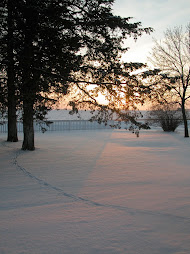
 I couldn't bear to upload another snapshot of the snow-covered farm yard, even though, that's really all I've got to offer you today. It doesn't matter which direction you look, all you can see is snow. The yard, the gravel driveway, the landscaping, the timbers, the woodchips, everything is buried under a solid crust of snow. To make matters worse, when you venture outside with a metal camera, your fingers get cold very fast. For a change of pace, I decided to get a bit artsy. Here's a shot Jim took (through the kitchen window), which I gussied up just a bit. Enjoy!
13 January 2008
The transition we call the ‘empty nest’
The term “empty nest” turned up often in conversation this weekend. One couple talked about having both of their twenty-something children move into their own places this year as a long-anticipated and welcome change for them. Another couple saw their eldest daughter walk down the aisle last fall and they felt no trepidation about the day their youngest, a college junior, would embark on a life independent from their household. (They were making plans!) Yet another couple whose youngest isn’t yet twelve, talked about the empty nest as if it held the promise of a Sun City, Arizona, retirement – all clear skies and recreation that they’d enjoy “someday.”
When my sons drove off to college last fall, I considered my suddenly empty nest as sort of a reward, like a gold watch handed over for eighteen years of faithful service to motherhood. I client of mine at the time warned me not to get carried away over my newfound freedom. “They come back,” she warned. “You’ll be amazed at how often they’ll be home.”
Of course, she was right. The empty nest, at least during the college years, is a transition stage to be sure, if not a full-blown myth. These new adults, it seems, hold fast to their ties to the nest as they venture out on newly stretched wings.

In nature, one sees empty nests fashioned from twigs and views them not as a home to which one returns, but as a place no longer needed. In a tree, an empty nest symbolizes abandonment. A move out of such a nest could have been spurred by the life cycle or the weather; the cause is irrelevant because what’s left behind no longer serves as a home. It is simply a shell, an empty nest. Life has moved elsewhere. All ties have been severed.
There is evidence of similar abandonment having occurred throughout the rural countryside. In Iowa, and to a lesser degree in Minnesota, entire farmsteads stand empty, monuments to lives fallen on hard times. It’s quite sad to come upon an abandoned farmhouse with its peeling paint, broken windows, and sagging front porch, because you feel certain that its one-time occupants didn’t wing off to a warmer clime just because the days got shorter. These old buildings had been homes, nests to entire generations, and some have stood empty for years, maybe decades. These, these, dear ones, are the empty nests of our world, the sad symbol of final departure – death, if only of someone’s dream.
And so, what to make of the term we apply to home when our teens-turned-twenty-something have run off to play house in a dormitory or apartment or townhouse? What of the “empty nest?” Well, it’s not empty at all even if we wander from one tidy bedroom to another, remembering the days when toys and laundry littered the floor. For as long as our birdies can wing themselves back for a visit, we can call the nest what it is: home.
When my sons drove off to college last fall, I considered my suddenly empty nest as sort of a reward, like a gold watch handed over for eighteen years of faithful service to motherhood. I client of mine at the time warned me not to get carried away over my newfound freedom. “They come back,” she warned. “You’ll be amazed at how often they’ll be home.”
Of course, she was right. The empty nest, at least during the college years, is a transition stage to be sure, if not a full-blown myth. These new adults, it seems, hold fast to their ties to the nest as they venture out on newly stretched wings.

In nature, one sees empty nests fashioned from twigs and views them not as a home to which one returns, but as a place no longer needed. In a tree, an empty nest symbolizes abandonment. A move out of such a nest could have been spurred by the life cycle or the weather; the cause is irrelevant because what’s left behind no longer serves as a home. It is simply a shell, an empty nest. Life has moved elsewhere. All ties have been severed.
There is evidence of similar abandonment having occurred throughout the rural countryside. In Iowa, and to a lesser degree in Minnesota, entire farmsteads stand empty, monuments to lives fallen on hard times. It’s quite sad to come upon an abandoned farmhouse with its peeling paint, broken windows, and sagging front porch, because you feel certain that its one-time occupants didn’t wing off to a warmer clime just because the days got shorter. These old buildings had been homes, nests to entire generations, and some have stood empty for years, maybe decades. These, these, dear ones, are the empty nests of our world, the sad symbol of final departure – death, if only of someone’s dream.
And so, what to make of the term we apply to home when our teens-turned-twenty-something have run off to play house in a dormitory or apartment or townhouse? What of the “empty nest?” Well, it’s not empty at all even if we wander from one tidy bedroom to another, remembering the days when toys and laundry littered the floor. For as long as our birdies can wing themselves back for a visit, we can call the nest what it is: home.
01 January 2008

15 December 2007
First Light of Day

This is a December sunrise as viewed from the bedroom of a 117-year-old farmhouse squat in the middle of a Minnesota prairie. (The shadow in the center is one of our four cedars.)
10 December 2007
The seasons of rural life
 There's more ice on the ground than snow, and that makes it easier for pheasants to scour the fields of corn stubble for food. The cleared fields also makes it easier to spot these beauties, but not necessarily easier to hunt them. The crunch, crunch under a hunter's foot will spook the pheasant pretty quickly.
Saturday, I spotted a flock of nearly two dozen ring-necked pheasants in the field across from ours. After awhile, the whole bunch of them scooted into the tall grass near the grove at the south end of the property.
I wanted a closer look, but haven't yet found where the boys put my field glasses upon their return from deer hunting. I had thought the pheasant season had passed, but one of our duck hunters stopped by Sunday to tell me otherwise. He and his dog will be tracking the birds during the last dark days of December.
17 November 2007
Fashionistas of the north country
 Three deer killed and counting is the report from Michigan's "renegade" peninsula.
Last night while walking the dog, I had a Cervidae encounter unlike I've ever experienced. A brave doe and I engaged in a minute-long stare down from about 15 paces. I puzzled aloud as to why she wasn't running away as I inched closer and closer -- closer than I've ever stood to wild deer. Her mate watched me from deeper in the marsh. It wasn't until the dog barked at her that she turned and darted into the darkness. It was at that moment, when the calm deer became a skittish one, when it dawned on me where the phrase "high-tail it" originated.
12 November 2007
Community is a state of mind
At a writer’s forum this past weekend, I spied a newly-published history book written about St. Clair, a town located close to Four Cedars Farms. The elderly author was at the forum, selling her book, and as I flipped through its pages, past block after block of text interspersed with historical photos, I asked her about her effort. The project took three years, she told me; if I had been “from” St. Clair, she added, I would recognize many of the family stories she’d included.
I nodded. Not recognizing me as a local, the author asked me if I was “from” St. Clair.
I was tempted to tell the woman that where we come from has little to do with who we are or where we’re going, but I thought better of it. “I’m from St. Paul, but I live near St. Clair now,” I replied.
“Oh. What brings you to St. Clair?” she asked with surprise, forgetting to ask my name or offer hers, or even shake my hand as a welcoming gesture — a hint that possibly my story might someday find its way into a subsequent edition of community history. I kept flipping pages, stopping only to gaze at the pictures. It’s a habit most writers despise; we believe our words carry more impact than the most striking accompanying picture ever could.
“I’m not sure how to answer that.” It was a lie. She was a lifer from rural Blue Earth County; she wouldn’t understand how stop-and-go daily commutes, airplane noise and nosy neighbors chip away at a city dweller’s enthusiasm for the commonly regarded perks of urban life — the parks, the good schools, proximity to culture. Furthermore, I suspect that my answer would have employed the term “escape,” which would only serve to raise her suspicion of me.
One year of country living has taught me most locals are quite suspicious of people like me – city bred people, interlopers who hadn’t inherited rural land so they had to buy their way in, or out depending on your perspective. Furthermore, I wasn’t interested in describing for her the interior changes that occur whenever my car leaves the pavement and rolls over the gravel drive as I approach the farmhouse. How could she, one who’s never traversed a Twin City freeway during rush hour, understand that even if you place on high price on serenity, many among us are still willing to pony up? Sales are driven by emotion, after all; city people understand this.
“I like the sunsets,” I finally said.
Her blank stare communicated more than her 250-page book ever could.
I asked her what the book cost.
“Thirty dollars,” she said.
It sounded to me like a big city price so I set the book down and walked away.
I nodded. Not recognizing me as a local, the author asked me if I was “from” St. Clair.
I was tempted to tell the woman that where we come from has little to do with who we are or where we’re going, but I thought better of it. “I’m from St. Paul, but I live near St. Clair now,” I replied.
“Oh. What brings you to St. Clair?” she asked with surprise, forgetting to ask my name or offer hers, or even shake my hand as a welcoming gesture — a hint that possibly my story might someday find its way into a subsequent edition of community history. I kept flipping pages, stopping only to gaze at the pictures. It’s a habit most writers despise; we believe our words carry more impact than the most striking accompanying picture ever could.
“I’m not sure how to answer that.” It was a lie. She was a lifer from rural Blue Earth County; she wouldn’t understand how stop-and-go daily commutes, airplane noise and nosy neighbors chip away at a city dweller’s enthusiasm for the commonly regarded perks of urban life — the parks, the good schools, proximity to culture. Furthermore, I suspect that my answer would have employed the term “escape,” which would only serve to raise her suspicion of me.
One year of country living has taught me most locals are quite suspicious of people like me – city bred people, interlopers who hadn’t inherited rural land so they had to buy their way in, or out depending on your perspective. Furthermore, I wasn’t interested in describing for her the interior changes that occur whenever my car leaves the pavement and rolls over the gravel drive as I approach the farmhouse. How could she, one who’s never traversed a Twin City freeway during rush hour, understand that even if you place on high price on serenity, many among us are still willing to pony up? Sales are driven by emotion, after all; city people understand this.
“I like the sunsets,” I finally said.
Her blank stare communicated more than her 250-page book ever could.
I asked her what the book cost.
“Thirty dollars,” she said.
It sounded to me like a big city price so I set the book down and walked away.
21 October 2007
Sunny Saturday in the Valley
When you farm, you never lack for something to do. Some days, our chore list seems as long as the prairie horizon; this is especially true as we prepare to face the harshest of times -- the approaching Minnesota winter.
But when the October sun decides to make a rare weekend appearance, and it brings with it what could be the last seventy-degree day of the year, the temptation to tour our scenic countryside proved greater than the need to store lawn furniture, mow lawn, or split wood. If you missed your chance to enjoy a sunny Saturday excursion, come along with me as I retrace the day we played "hookey" from the farm.
The heavy rains of September and October have pushed water up and over the banks of our area rivers. This is the Le Sueur River, which spills into the Blue Earth River just beyond the Red Jacket Bridge. The valleys where these two waterways converge and then spill into the Minnesota River, offer spectacular views when the trees are showing good color.
But when the October sun decides to make a rare weekend appearance, and it brings with it what could be the last seventy-degree day of the year, the temptation to tour our scenic countryside proved greater than the need to store lawn furniture, mow lawn, or split wood. If you missed your chance to enjoy a sunny Saturday excursion, come along with me as I retrace the day we played "hookey" from the farm.
The heavy rains of September and October have pushed water up and over the banks of our area rivers. This is the Le Sueur River, which spills into the Blue Earth River just beyond the Red Jacket Bridge. The valleys where these two waterways converge and then spill into the Minnesota River, offer spectacular views when the trees are showing good color.
 The Le Sueur River
 Red Jacket Bridge over the Le Sueur River
After stopping to enjoy the fast moving river currents, we moved on to Minneopa Falls, just south of downtown Mankato. Minneopa is a Native American word that means “water that falls twice.” A walkway extends between the upper falls and the lower falls, which drops thirty-nine feet.

The upper and lower Minneopa Falls

Not far from the falls, we picked up scenic highway 68, headed west toward New Ulm. Before reaching the town of Cambria, we turned off the highway in order to visit Morgan Creek Vineyard, one of only a dozen wineries in Minnesota. In the tasting room, three dollars allowed us to sample ten Morgan Creek varieties. When we finished sampling, we purchased two bottles, a semi-sweet La Crescent variety called Zeitgeist, and a dry red called Saint John’s Reserve. After wandering the grounds, we decided a bit of food might be a good idea before climbing behind the wheel. We each ordered a six-inch pizza from the brick-oven on the veranda.
 Morgan Creek Vineyards, South of New Ulm, Minnesota
 New Ulm offered us another scenic respite – the August Schell Brewery, the state’s oldest brewery perched on the banks of the Cottonwood River. Unlike the Winery, the Brewery was crowded and the tours booked for hours. There was a wedding taking place at the Schell Mansion and Gardens, below. We weren't sure if the peafowl wandering up the path were invited guests, or if they were crashing the festivities.

 We wandered briefly then headed into town, looking for an authentic German meal. We found one at the Kaiserhoff. A Schell's Oktoberfest, on tap, went perfectly with the sausage, sauerkraut, pumpernickel bread and German potato salad.
15 September 2007
Friday's drive to the farm
On the walk from the car to the front door of Jim’s Apple Farm, you start to think it must have been a good year for pumpkins. The lot is lined with them, hundreds of them in all shapes and sizes – your choice, only $2.98. When you reach the door and push it open, you forget the pumpkins, forget the cars buzzing past on Highway 169, and forget the week on which you just closed the door.
It’s the polka music that gets you. It’s the 2/4 beat oohm-pa-pa of tuba paired with accordion that calls up the bohemian in you and makes you forget the life you forged for yourself long before you were ever qualified to make such decisions. Suddenly you’re a child skipping between apple barrels and tables piled with strudel and pie. You see the jars of pickled eggs, pickled beets and pickled pickles, but the table of homemade fudge is far more appealing and even that doesn’t hold your attention for long because behind it are bags of colored popcorn stretched out like a rainbow and beyond that, more tables spread with more than 200 varieties of candy.
The 2/4 beat ends, replaced by a 3/4 beat. You’re heart stops racing and you examine the candy that sweetened your childhood – wax lips, candy cigarettes, licorice pipes, snaps, rock candy, Swedish fish, Blackjack, root beer barrels and jawbreakers. Slowly, nostalgia wanes and you recapture a remnant of the self that stepped out of the car earlier. You came in for apples, you remind yourself. So you step over to the tasting table to see if there’s an apple that tastes better than the tart Haralson, the variety that pulled you toward the parking lot in the first place. There is. It’s called Honeycrisp.
But your senses get bombarded again, this time from the ovens in the back where dozens of pies bubble. You recall that you hadn’t eaten dinner and the individually wrapped bars of strudel are more temptation than one hungry human can bear. You grab one, and then grab a bag of Haralsons because the Honeycrisps are too expensive. Then you head for the register, trying not to notice the caramel apples sitting on the counter.
You pay the young man who has spent his entire day among the sweets in order to pay for his education. He’s ready to leave too. You exchange smiles, grateful for the chance to escape this den of temptation, this barn-full of fruit-filled pastry and candy concoction. You’re back among the pumpkins. And then you’re back in your car. The strudel is gone.
Before you turn back onto the highway, you make one quick scan of your radio looking for polka. Nothing. You frown.
It’s the polka music that gets you. It’s the 2/4 beat oohm-pa-pa of tuba paired with accordion that calls up the bohemian in you and makes you forget the life you forged for yourself long before you were ever qualified to make such decisions. Suddenly you’re a child skipping between apple barrels and tables piled with strudel and pie. You see the jars of pickled eggs, pickled beets and pickled pickles, but the table of homemade fudge is far more appealing and even that doesn’t hold your attention for long because behind it are bags of colored popcorn stretched out like a rainbow and beyond that, more tables spread with more than 200 varieties of candy.
The 2/4 beat ends, replaced by a 3/4 beat. You’re heart stops racing and you examine the candy that sweetened your childhood – wax lips, candy cigarettes, licorice pipes, snaps, rock candy, Swedish fish, Blackjack, root beer barrels and jawbreakers. Slowly, nostalgia wanes and you recapture a remnant of the self that stepped out of the car earlier. You came in for apples, you remind yourself. So you step over to the tasting table to see if there’s an apple that tastes better than the tart Haralson, the variety that pulled you toward the parking lot in the first place. There is. It’s called Honeycrisp.
But your senses get bombarded again, this time from the ovens in the back where dozens of pies bubble. You recall that you hadn’t eaten dinner and the individually wrapped bars of strudel are more temptation than one hungry human can bear. You grab one, and then grab a bag of Haralsons because the Honeycrisps are too expensive. Then you head for the register, trying not to notice the caramel apples sitting on the counter.
You pay the young man who has spent his entire day among the sweets in order to pay for his education. He’s ready to leave too. You exchange smiles, grateful for the chance to escape this den of temptation, this barn-full of fruit-filled pastry and candy concoction. You’re back among the pumpkins. And then you’re back in your car. The strudel is gone.
Before you turn back onto the highway, you make one quick scan of your radio looking for polka. Nothing. You frown.
14 September 2007
Along the migratory trail
 Every fall, monarch butterflies migrate to Mexico. By instinct alone, the butterflies go to the same mountains that their ancestors left the previous spring. Somehow, they find a place in they've never before been. This one stopped by Four Cedars Farms for a rest the other day. I trust it has perhaps reached its destination by now.
15 August 2007
The Dog Days of Summer
Rain. It’s the spindle around which most folks today wrap their conversation.
More specifically, it’s the lack of rain that now keeps farmers awake at night and gives those town folk who pass by fields of shriveled corn and dormant soybeans reason to stop by the neighbor’s place to share their woe. And why not rail on about the weather? It’s really the only topic on which all people – democrats and republicans, professionals and working class, old and young, city bred or rural – can agree. Mother Nature wields her wrath without prejudice. Six steady weeks of cloudless sky will scorch the rich man’s ground as thoroughly as it does the poor man’s. On cracked earth, people can find common ground.
Despite the drought, the soybean field across from Four Cedars Farms maintains the perception of health; the field is richly green and the leaves bow to a southeasterly breeze in supple waves. At the foot of a muggy breeze, the crop looks alive – vibrant. It is a lie. The plants have shut down and unless a significant rain comes soon, this crop will be as worthless as the corn crop that some farmers around the state have already begun to plow under.
And this is farming. You work the ground to ensure the proper nutrients are present for the seed you eventually sow – always with optimism. You fight bugs and weeds and late spring frosts and mechanical breakdowns (which occur more regularly than rain) and then, you wait. And you hope.
Each year the challenges come in different form, but reliably each year, the challenges arrive. This year, the challenge is drought, and the solution isn’t sitting on a shelf at Tractor Supply. This is farming – as seen over the fence at Four Cedars Farms.
More specifically, it’s the lack of rain that now keeps farmers awake at night and gives those town folk who pass by fields of shriveled corn and dormant soybeans reason to stop by the neighbor’s place to share their woe. And why not rail on about the weather? It’s really the only topic on which all people – democrats and republicans, professionals and working class, old and young, city bred or rural – can agree. Mother Nature wields her wrath without prejudice. Six steady weeks of cloudless sky will scorch the rich man’s ground as thoroughly as it does the poor man’s. On cracked earth, people can find common ground.
Despite the drought, the soybean field across from Four Cedars Farms maintains the perception of health; the field is richly green and the leaves bow to a southeasterly breeze in supple waves. At the foot of a muggy breeze, the crop looks alive – vibrant. It is a lie. The plants have shut down and unless a significant rain comes soon, this crop will be as worthless as the corn crop that some farmers around the state have already begun to plow under.
And this is farming. You work the ground to ensure the proper nutrients are present for the seed you eventually sow – always with optimism. You fight bugs and weeds and late spring frosts and mechanical breakdowns (which occur more regularly than rain) and then, you wait. And you hope.
Each year the challenges come in different form, but reliably each year, the challenges arrive. This year, the challenge is drought, and the solution isn’t sitting on a shelf at Tractor Supply. This is farming – as seen over the fence at Four Cedars Farms.


Subscribe to:
Posts (Atom)