Showing posts with label Hobby Farming 101. Show all posts

17 January 2010

Sometimes all it takes is a windless day...

People unfamiliar with grape growing are often surprised to learn that there is much work to be done in the vineyard in what they'd presumed to be our "off-season." The bulk of the work falls under the category of pruning, but it is far different from the pruning we do in late spring and early summer. In winter, we are assigned the task of dormant pruning, a critical task that affects the quality of the harvest we hope to enjoy about nine months from now.

There is a formula one can follow to determine how to prune (30 buds left behind per pound of wood removed) but simply put, we leave as many buds as we think our plants can effectively ripen next season and remove the remainder of last season's growth. As you can see from the photo above, that's a lot of wood to be cut, hauled out of the vineyard, and burned.

Cutting is something we've gotten quite proficient at here as we approach our third growing season. And we've even got quite adept at gauging optimum pruning weather. Hint: we ignore the forecast and walk outside. If the temperature exceeds 20 degrees and there's no wind, we prune.
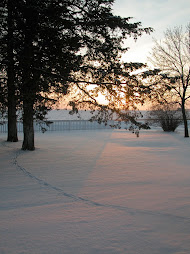
This winter, though, we've been challenged by excessively deep snow. A walk down one row is currently an extreme cardio workout, so much so that we've adopted a new pruning strategy.
Now, we trudge down the rows, pruner in hand trying not to get stuck or tip over, make our critical cuts, and leave all the wood hanging in the trellis. (It's not going anywhere).
This is all we can manage in knee-deep snow. This way, we can be assured of getting the work done that absolutely needs to get done. When the snow melts to more modest levels, sometime between next week and May, we can get back down the pruned rows to clean the wood out of the trellis.

My children urged me to invest in snow shoes to ease the process. I hedged at first. Then my son reminded me that this probably won't be the only winter I'll prune in deep snow. The snow shoes are in transit.

23 November 2009

Prepping for the inevitable...

We've been blessed with one of the warmest Novembers on record. Not to sound ungrateful, but we were due; our October was one of the coldest, wettest in history.

But now the first wave of what is being billed as "a change" in our weather has arrived in the form of rain. Hubby spent much of today and yesterday winterizing the summer equipment and getting the landscape set up for winter, which really means getting set up for me to manage winter.

Just before sunset, we finished running snow fence along the driveway in an attempt to minimize drifting and then he gave me a 45-second tutorial on how to operate the bobcat. If I want to leave the house this winter, I will need to master this powerful and confusing piece of heavy machinery. I go through the steps deliberately, thinking that there's no reason I can't master this, that my gender has no relevancy to my understanding of a mechanical process and my clear lack of upper body strength, which puts me at a disadvantage in so many other situations around this farm is more than compensated for here by virtue of hydraulics. I am woman, hear me (in my bobcat) roar.

I spend a few minutes directing the bobcat around on the gravel, simulating what I believe to be the process of pushing, lifting then dumping snow (an easy simulation when it's 43 degrees outside) and then I back the machine into the shed and turn it off. I'm ready now, ready for whatever winter throws at me. I'm ready. So long as the bobcat starts.

03 November 2009

Crops are in; nowhere to hide!

I spotted this guy in the vineyard, but by the time I was able to grab the camera, he'd crossed the driveway. He was moving fast! Running for cover I presume.

30 September 2009

Coming to expect the unexpected...

The old farmhouse has a checkered history. The land had once been home to Winnebago Indians, but the Torrens title makes no mention of that; the official record says only that the land was decreed by President Grant into the homestead of a man named Phillips, whose descendents still farm the thousand or so acres that stretch as far my gaze allows. The neighbor to the north, one of those descendents, told me recently that my house had once belonged to his grandfather. A neighbor who lives three farms to the south, meanwhile, told me she used to baby-sit for the family who lived here after Grandpa Phillips moved on. The house had changed a lot, she said. Indeed. I’ve been trying to piece together its history for three years now and all I’ve been able to muster is similar to what you get when you take a picture at noon on a sunny day – contrasting outlines devoid of fine detail.

Before I left home last week to attend to family commitments in the city, I closed the storm windows trying to hold on to late summer’s heat knowing autumn’s chill loomed close. On my return this morning, I was met with an inside temperature of 62 degrees F., hardly tolerable for the warm-blooded soul that I am. Fortunately, the chill was temporary, for today we made another entry into our family’s chapter of “farmhouse history.” Today, we added a wood stove to give us supplemental heat.

It made sense for us to supplement our furnace heat with wood heat because wood is so plentiful here; we chose to place the stove in the kitchen because it is the coldest room in the house, running about five degrees colder than the two story section of the main house.

In preparation for the installer’s arrival, hubby and I cleared out the upstairs hall closet where, at the back, there is hidden a small door that opens into the attic above the kitchen. Before this past week, we’d never really taken a serious look at the attic above the kitchen, so we were a bit concerned to open the door to find that the wall and roof boards near where the stove chimney would rise from the kitchen ceiling toward the outdoors was charred black. And I mean charred BLACK. There had once been a fire! Our farmhouse had had a fire!

With flashlight in hand, we tried to piece together the events that left part of our attic blackened. We wondered where the fire had started, how it hadn’t spread to consume the whole house, and why, for heaven’s sake, the charred boards had never been replaced! There were no answers for us up there. Like much of this farmhouse’s past, we have only conjecture and scant memories from distant neighbors. Oh well.

The wood stove went in on schedule and in it, a fire — a glorious warm fire for the last day of a warm September that departs with an undeniable chill. The temp in the kitchen, as I write this, is 75 degrees F. For now, we’ve forgotten about the fire that once crept up the wall into the attic. We’ll get back in there soon to replace the charred boards that should have been ditched long ago. Why they weren’t we’ll never know. That’s just how it goes with an old house with a mysterious past. Sometimes, you just never know what you’ve got — until you’ve got it.

24 August 2009

An ancient grain with bright future...

Chef son and I mastered Gluten Free Kibbi Nayyi using both Quinoa (his choice) and Amaranth (my choice). Each substitute grain garnered us taste and texture virtually indistinguishable from the Bulghur or cracked wheat that is traditionally used in the dish. I now have gained confidence to try a Tahbouli Salad with Amaranth, which closely resembles Quinoa in taste, texture and nutrition. I like Amaranth better, though, because this weekend I learned it may be something I can cultivate myself here next summer. And who knows where that might lead?

Beyond the borders of the United States, Amaranth is used in interesting ways. In Mexico it is popped and mixed with a sugar solution to make a confection called alegria or happiness. Milled and roasted amaranth seed is used to create a traditional Mexican drink called atole. Peruvians use fermented amaranth seed to make chicha or beer. Amaranth can be cooked as a cereal, ground into flour, popped like popcorn, sprouted, or toasted. The seeds can be cooked with other whole grains, added to stir-fry or to soups and stews as a nutrient-dense thickening agent. Amaranth flour is used in making pastas and baked goods.

Amaranth seed is 15 percent to 18 percent protein and contains respectable amounts of lysine and methionine, two essential amino acids not frequently found in grains. It is high in fiber and contains calcium, iron, potassium, phosphorus, and vitamins A and C. The fiber content of Amaranth is three times that of wheat and its iron content is five times more than wheat. It contains two times more calcium than milk. Using Amaranth in combination with corn or brown rice (or wheat) results in a complete protein as high in food value as fish, red meat or poultry; great news for vegetarians.

The name Amaranth is Greek for "never-fading flower" and its flower is what caught my attention yesterday. My friend Diane has three stands of Amaranth growing in her field, though she grows it purely for ornamental value. Amaranth is a bushy plant that grows five to seven feet tall with broad leaves and a showy flower head of profuse burgundy plumes. Hers are quite striking in her voluptuous bouquets.

But what intrigues me the most about Amaranth is that it seems easy to grow and though the seeds it produces are tiny, each plant is capable of producing 40,000 to 60,000 of them. I just paid about five dollars for a 16-ounce package of whole grain Amaranth, and a 22-ounce package of Amaranth flour goes for about eight dollars. I’m not saying I’m ready to plow under all my grass to sow Amaranth, but I can do simple math. I think it’s time to do a bit more experimentation in the kitchen to see exactly how valuable Amaranth can become!

19 August 2009

Fearlessness in the modern kitchen...

A few weeks ago, hubby and I snuck away from the farm to see the film Julie & Julia. The movie tells two stories: Julia Child’s journey to learn and ultimately teach French cooking to ordinary Americans, and Julie Powell’s journey to make a name for herself as a writer as she attempts to master Child’s tome, Mastering the Art of French Cooking. While it may seem obvious that the film is aimed toward those who, like me, enjoy cooking — and the cooking scenes carry the film — the film also offers witty dialogue and an exploration of themes that emerge in life beyond the walls of the modern kitchen.

My favorite line of the film comes early, when Julia Child is pleading for her cooking certificate after finishing coursework but failing her final exam at Paris’ Le Cordon Bleu School of Cooking. Child confides to the woman who heads the school the she is determined to teach American women French cooking. The headmistress is unconvinced of Child’s ability in the kitchen, but eventually gives into her pleas and grants her a certificate. “Go ahead and teach the Americans what you know,” the woman snips, “they won’t be able to tell the difference anyway.”

Child spent years experimenting and perfecting recipes for Mastering the Art of French Cooking, yet when she taught, she stressed the joy of working with food and urged her students and fans not to stress out in the kitchen. Cooking should be fun; so should eating! And is there a better way to enjoy life than to cook a meal and then share it with those you love? Why would anyone choose take-out meals or pizza delivered in a cardboard box over the joys that emerge from a busy kitchen? In this regard, I believe the French have one-upped us.

I spent the better part of a rainy day in the kitchen, processing and freezing garden produce and planning meals for the upcoming weekend and beyond. It’s just me and the cat here in the kitchen, which helps me stay on task though I wistfully wish I had friends or children or the children of friends with me here to share the joys and benefits of working with real food, defined as food without packaging or an ingredient list a quarter of a mile long. I can endure the quiet, though, because it is short-lived.

Two autumns ago, my cousins and I learned how to make Kibbi Nayyi from an elderly but spry Lebanese woman affectionately called “Auntie Mary.” Soon after perfecting the technique, I learned neither of my sons can tolerate the cracked wheat integral to the dish. This weekend, my son and I will experiment making Kibbi Nayyi with toasted Quinoa or perhaps Millet, if I can get my hands on some. Experimentation is what makes cooking so wonderfully rewarding; it’s also what scares most people out of the kitchen. In 48 hours, the food processor with be spinning and raw meat will be ground and spices will be mixed, either with mortar and pestle (my choice) or food processor (son’s choice). I’m unsure if our trials will lead to a breakthrough – a gluten-free Kibbi Nayyi – or not. But we will certainly enjoy the process; we will be “mastering the art of cooking,” which isn’t an accomplishment reserved only for the French.

Julia, we will not be afraid!

12 August 2009

Real food, enjoyed by real people...

Did you know a pork butt comes from the front leg of the pig, which is nowhere close to, well, a pig's actual butt? What gives?

Of course, a pork butt is also known as a pork shoulder. Now that makes sense to me. Then of course, there's the Boston Butt, which is close to the same thing, though my son will probably clarify this for me. I'm not sure when the pig was in Boston, or if he's even a Red Sox fan.
Company came so I slow-cooked a pork shoulder in apple cider to make pulled-pork sandwiches. The cooking tip came from Heidi. So did the pork. We (me, Heidi and the pig) got rave reviews on the meal from those who came for a visit and got a tour and lunch. We closed the meal with Janice's strawberry pie. (I like to give credit where it's due.) No leftovers on either the pork or the pie, by the way.
The meal put one of my guests in nap mode, which in my mind is the highest compliment one can pay a chef, even an amateur chef like me. Lucky for him, I didn't listen to my dad and sell my swing. It doesn't get used much, it's true, but still it's nice to have when a friend needs some shut-eye.
All in all, it was a good day filled with good food and company, another rarity around here. Yes, it was a good day. A good hot summer day. At last!!

09 July 2009

My one-way conversations ...

A few months ago, I entertained the thought of pulling the plug on this blog. But I didn't and today, especially today, I'm glad I didn't.

There are days when, beyond a few brief cellphone calls, my only connection to other people is found right here. I don't say that to elicit pity. This is the life I chose for myself after months of deliberation; those of you who've followed this blog since 2007 probably remember those cryptic essays I posted while I was talking myself into leaving the familiar and resettling here. And at my age! Then, as now, the blog is my way of keeping in touch with you as much as it is (I assume) your way of checking in on me. The latter is a leap on my part, but the regularity in which some of you post comments tells me it's not a huge leap.

I like this blog because it allows me to share with you the unexpected treasures of living in this wonderful place on the prairie, this place that requires so much work yet delivers so much reward.

Last week, on the long road to Michigan, I was rereading my grape-growing text to bone up on the goals of second-year vine pruning. I'll spare you the jargon and condense things to two words: air flow. In most of this breezy vineyard, air flow is not a problem. And then there is Row 16. This is the row closest to the road, the row that tells passers-by that I am a grape-growing goddess, the row that was planted first. Row 16: It will be the death of me, I'm sure.

I was in Row 16 with my pruners this evening trying to create air flow. If you look at the picture below, you'll see this is no easy task. There's a post in there if you look closely. The actual vines are planted four feet on either side of the post. Keep in mind, these are second year plants. This is Row 16. If these grapes had been planted by the government, I'm sure there'd be some sort of investigation into why these plants are growing like this. Surely, there's be a Senate sub-committee... I cut and pull and cut and pull and toss the clippings into the trailer that hubby has rigged up behind the golf cart. The cuttings in the photo below come from six plants. I know!


And then this... as I examine the growing pattern of Row 16, Plant 2, in order to see where I should cut...this...

A smile washes over me. The little nest is about the size of a teacup saucer and inside, three tiny blue eggs. It's this discovery that reminds me why I love it here, even when there's no one to talk to. Then I remember that I can share this surprise with you here, on this silly little blog that I almost deleted but didn't. Another smiles washes over me. Thanks for listening.

29 June 2009

Four Cedars Folly: Three Years In

We celebrated our third anniversary here at the farm this past weekend. Not suprisingly, the weekend went a lot like that first weekend went back in 2006: We worked like oxen from sun-up to sun down then downed a few Aleve along with a few beers.

What were we thinking?
Three years ago, we asked ourselves this question often. Then, most of our energy went toward rectifying decades of neglect. It was easier to get past our aches and pains when we could just blame the previous owner(s) for not knowing -- or caring -- how to maintain a property so its value appreciates. We'll turn the place around, we told ourselves. Once the dirt and debris gets cleared, we'll be in the clear too. Ha!

Then we got an idea to plant grapes; whether it was a good idea remains to be seen.

About a month into farm ownership, we met a nice fellow from town who struck us as the kind of guy who can get things done. We shared our idea with him and asked him if he knew a guy who might have a plow for hire. He did. The pasture needs to be turned, we told him. (We were thinking ahead). He nodded and promised to take care of it, which he did.
We ran into this fellow this weekend. He complimented us on our vineyard. "I always wondered if you knew what you were getting into," he admitted to us. Clearly, we didn't I told him, laughing on the outside but aching on the inside.

The experienced grape growers have told us that we will grow and learn as our grapes grow. This June, I learned that year two requires as much effort as year one. It is a painful lesson.
Last week brought us almost 3.5 inches of rain and temps in the 90s. Good growing weather for anything green. Three days before the above picture was taken, weeds outnumbered vines by roughly 20 to 1. But this post isn't so much about weeds; I spray herbicide to kill weeds. First, though, I had to go up and down the rows getting the robust vines, which were twisted and sprawling in any number of ways, pruned and tied to the trellis.

You can see what I mean, eh? I have to stick my head into this tangled mess and select two straight, upward growing lateral shoots that look as if they have the potential to give me a healthy crop in 2010. Everything else gets cut. It takes about 10 minutes and requires much patience and critical thinking. In spite of the mess of potential in front of me, there is a right path; deciding takes faith. It sort of reminds me of parenting teenagers, except this also requires bug spray.
Hubby told me he'd rather pull weeds than prune. Tony and Shannon spent the day helping with this task and both told me they saw twisted mangled vines in their dreams. They stopped short of calling them nightmares. I'm grateful.
Once the vines are up off the dirt like this one, I just have to wait for the breeze to abate before heading into the rows with the herbicide sprayer. I've discovered the calmest hour of the day is at 5 o'clock in the morning.

Last Thursday as I pruned in the hottest part of the day, I again asked myself: What was I thinking? I know only a few women who, in blistering heat, would ignore biting flies and dirty fingernails in order to create something lasting -- something beautiful. Wouldn't I be happier, I asked myself, if I were in an air-conditioned coffee shop sharing thoughts on the latest best-seller, all manicured and comfy? I push the thought away and convince myself instead that I'm putting my energy toward something special.
What was I thinking? I was thinking grand. I was thinking beautiful. I was thinking legacy.
Fortunately, I have been blessed to know some women who, like me, are willing to work hard and get dirty in order to achieve big things. They inspire me to push ahead down the rows.

17 June 2009

Where did this come from?

It had been London-like for most of a day and a half. Low clouds. Cool temps. Occassional drizzle. Then the sun came out for the hottest part of the day, 3:00 to 6:00 pm. Then, it got Kansas-like, in a big fat hurry.

By 7:30, I had tornado warnings 15 miles to my east, 10 miles to my north, and 20 miles to my south.

02 June 2009

Thoughts on adopting a cat...

The new cat likes attention, which is, I presume, a feature found in most pets.

For the briefest of moments yesterday, the meowing hit a level that drove me outdoors. Fortunately, that meant a walk to my neighbor's place down the road. The exercise was good; the weather, perfect. I enjoyed a nice visit with Jill, a mother of two children under age five, who also has two cats, four kittens, 26 chickens, and one large dog whose favorite toy is labeled "hyper-dog."

Twenty minutes at Jill's animal farm assured me that one small cat and two wandering hens are manageable for one who has 650 grapevines, and a business, to tend.

The new cat also likes window sills, which is great until his caregiver decides to close the window without telling new cat. He jumped, he smacked the glass, he returned to the floor. This is comedy at its basic level, folks.

31 May 2009

New to the old farmstead...

Farm cat...
Formerly known as Elroy...
Enjoying the view... Farm dog, meanwhile, is likely spinning in his grave.

25 May 2009

The bridge between Spring and Summer...

It's been a blustery spring in these parts, which helps keep me on task at the keyboard. The holiday weekend, however, brought two consecutive days of warm temps, calm winds, and sparkling skies. Under these conditions it becomes clear that I need get away from the computer and get outside to see what's transpired around the property.

We scouted the vineyard and found both good news and bad. First the good news: there's lots of vigor to be seen, especially among the Marquettes. And by vigor I mean that the Marquettes have put out grape clusters, and lots of them. (See the red arrows in the photo below.) While cluster thinning is an annual routine in a vineyard because a vine will always produce more clusters than it can effectively ripen, our year two plan is to remove all clusters so the plant can focus on root and trunk development. We made quick work of pinching them off.

Now the bad news: We suffered frost damage that hit all the plants, but the Edelweiss seemed to suffer the worst of it. If it were a fruiting year, a late May frost could devastate the crop. Fortunately, this is not a fruiting year. So the plants have been set back in their progress. Many of them lost all their shoots. I'll be watching them closely to see how quickly they recover.


Also this week, Heidi was back to finish up the grapevine mural. We are thrilled with her work.
Lastly, we finally got around to burying farm dog's ashes. The family bought me a marker to set above his plot, a nice reminder of the world's sweetest dog. Next week, we're welcoming a cat to the homestead. His official name is Elroy, but I expect he'll mostly be referred to around these parts as "farm cat." I've never owned a cat before; it could be an adventure.

I heard a line at Mass yesterday that seemed especially fitting for Memorial Day. "Live a life worthy of the price that was paid for it." God bless you and thanks for stopping by.

20 May 2009

A gritty day all around...

I've seen pictures of the Dust Bowl and today wasn't quite so dire. Still...

the wind today, which was a simple amplifaction of the powerful wind of yesterday, was notable.

For instance, after opening the windows upstairs for the first time in nearly eight months, I was forced to promptly reclose them because surfaces were covered in dirt...

Then, I noticed that the small tomato plants that I'd hoped to put in the ground had disappeared; the plastic tray, blown apart, and the seedlings simply gone...

the bench, the Adirondack chair, the swing, the rocker, all tipped over...

the gate to the vineyard, swung wide and moving...

the buckets holding place for coming Iris plants, those I caught rolling across the front lawn...

I spied a half-dozen geese grounded, wandering the back lawn...

and finally, the air at the horizon and halfway up to heaven, well, it resembled the Los Angeles basin any day of any summer. It was thick air. Brown air. Dirt air.

Maybe it wasn't the Dust Bowl here today. But it was something. Maybe, it was the Dust Saucer.

18 May 2009

Garden class inspired him...

The men in my life are fond of saying: "Go big, or go home." Usually, the phrase is tied to horsepower or firepower or the size of the bonfire out back. The thinking goes, I presume, that more is better. But more can also mean more work, as in more general care. Oftentimes general care, or upkeep, falls into my column of the chore list.

As I mentioned in an earlier post, hubby and I have been taking gardening classes from Diane Selly of Earthworks Gardens. I've enjoyed the lessons thinking they would help me take better care of the plants we already have. Hubby, meanwhile, had other ideas, such as waiting until I was away for a day to build a new perennial garden. He didn't have a plan. His only driving theme: Go big, or go home! This is the south side of the house, along the kitchen, where he told me it was very difficult to mow the grass, which were mostly weeds anyway. (Folks, I've mowed here often. It wasn't that tough!)
The love birds, meanwhile, loved the idea of playing in the dirt. All the better for finding worms. When the plot was cleared, and I got over my shock at the chore that is planning a flower garden, I did what any smart woman does. I cried for help. Fortunately, Diane came to our rescue and out to St. Peter, and Earthworks Gardens, we went. Diane sketched us a plan, then walked us around the field to show us some options. When we made our choices, we dug them out. (No potted perennials here!)
We chose Baptisia for the back, Penstemon for the center, and Iris, Daylilies and Tanacetum for the front, and one perennial Oregano plant. Diane also gave us Flowering Almond and we moved in some wild grass from elsewhere on the property. Then we chopped everything down, as Diane instructed. The upside down buckets are holding the place where the Iris will go. We filled the surrounding area with shredded tree mulch.
It doesn't look like much now, but I'm expecting by late July, the garden will look gorgeous. It better. It took the entire weekend. And for the record, the next time hubby says to me "Go big, or go home," I intend to tell him to go home.
After all, I still have 650 grapevines that need my attention.

14 May 2009

Life's a blank canvas; add whimsy!

This is my friend Heidi. She runs a successful decorative painting business. Heidi and her husband Chuck also are farmers (Thompson's Painted Hill Farm) who raise heritage breed cows and pigs in Wells, Minnesota; their farm products are Certified Naturally Raised, which is a designation on par with products that are Certified Organic, though meant for small producers for whom reporting requirements mandated by the USDA program are prohibitively expensive.

Heidi is also a brand new author! Today, she handed me her book, part memoir part farmstead cookbook, when she stopped by to spice up the old granary.

I tell you, when I look at this picture of Heidi, I have a hard time picturing her tracking around the farm in muck boots. Yet I've seen it with my own eyes.

I first learned Heidi was writing a book in January, and when I got my hands on her manuscript, I couldn't believe the stories held within. You see, Heidi and Chuck were raised in a metro area. Their first house was in Minneapolis. You know the neighborhood; it's the one where you can see into your next door neighbor's bathroom everytime you grab a glass of water from your kitchen faucet! Heidi has such a story in her book, along with all the trial and error her and Chuck went through as they transitioned from city to country.

Her tale resonates with me, though she and Chuck dove into the deep end of farming. I'm still sitting on the edge of the pool, splashing water with my feet. Heidi and Chuck also have five dogs, five BIG dogs, each one sweeter than the next. The dogs have their own chapter.

Heidi's recipes are pretty terrific too, and there's lots of them. I recommend using the pork or beef or chicken they raise on Thompson's Painted Hill Farm. Visit their web site to find out where to buy it, or buy direct. Heidi also includes a few recipes from my other farmer friend, Janice Guldan, who happens to be one of the best cooks I know.

You can learn more about Heidi's book on her blog. Heidi says at the end of her book that she's just opinionated enough to be dangerous -- to herself. I hope not.

After handing me my autographed copy, Heidi took stock of the blank canvas known also as "the big birdhouse." Personally, I think she spent more time looking at the ladders than the building.

Heidi's two hour break from farm chores in Wells gave us this. She promised to return next week to plant, I mean paint, the other side. I'm thinking this is just what a boxy, old farm building needs -- whimsy!

I'll update you when it's finished.

16 April 2009

The animal farm in spring...

Now that spring has sprung, I'm spending a lot more time milling around the farm by myself. Farm dog's absence weighs on me as, around mid-morning, I wander out to the chicken coop to collect the pair of eggs that wait.

The two brown hens can be relied upon to scamper to my feet in welcome, as if they want to remind me that I'm not alone; they even stoop at my feet so I can pet them, which I sometimes do. But it's not the same. I recognize that they are smart and have personality, but they are chickens and I'm a dog person. A dog person without a dog.

Yet, the absence of farm dog has changed the nature of the landscape. Farm dog did more than trot happily off-leash around the property; he pretty much patrolled the land. He chased away birds and squirrels and ferreted out other four-legged intruders whether they be mice, rabbits or the occassional possum. It was also well-documented that he barely tolerated the visiting sheep. So with the exception of the two hens, this was a one-animal property for more than two years, and farm dog was top dog.

But now spring has sprung and life, and that means wild-life is encroaching on what was once unsafe territory. Last week, two mallards meandered around under the four cedar trees. A few days later, two Canada geese took a break in the backyard. I spied two jack-rabbits playing tag by the granary. Down by the water, I spent a half hour rapt in the sound of an avian symphony rising from the dried reeds and catttails. And, shortly after leaving the shoreline, a ringneck pheasant stepped into my place. And then, just yesterday as I took a book break out back, my concentration was broken by incesant nibbling from this one...
...and so the brown hens are correct. I'm not alone. I'm surrounded by creation, which is a good place for a "creative" type to be. I still miss farm dog...but it would appear, at least among the creatures who inhabit Four Cedars, I'm the only one.

14 April 2009

Do you want fries with that burger?

I was reminded that I hadn't updated you on the status of mini horse.

While we vacationed, the mini horse's owner traded in mini for a full size model. Horses, it seems, are more like cars than pets in this regard. So, no mini for me. (Or no "Mini Me," a nod to you Austin Powers fans.)

I was also reminded that horses can be consumed, and indeed are consumed, throughout much of the world. Although there isn't a market for horse meat in the U.S., there are processing plants where meat is prepared for export. These plants are in the crosshairs of the Humane Society of the United States, though, and a bill to outlaw these plants is moving through the halls of Congress. (It's good to see elected officials getting down to the important business of keeping our nation safe from horse meat.)

And speaking of safety as it relates to meat, I was reading an article in Midwest Ag Journal about improving feedlot technologies to improve profitability. The article examined the when, why and how of applying growth-promoting implants in feedlot cattle, a practice underway at 92 percent of all feedlots. I'll spare you the technicalities except for this tidbit ... the implants that are given to cattle between one and three times to accelerate growth (and thereby profitability) are mostly medium-potency estrogen...

Enjoy your hamburger, fellas.

26 March 2009

A suprising week...

With age comes wisdom. At least, we hope that's the case. Certainly, age gives us the kind of "I recognize this because I've seen it before" kind of insight that sometimes means even the worst of times can be viewed as a temporary hiccup in the otherwise rhythmic pattern of life. Weather and the seasons are just one example. It gets warm, we get excited; cold returns and we get crabby. I've seen this before. It's called March.

But every now and then, like you, I am struck by something I hadn't expected. Like on Tuesday, when I looked at the rippled landscape and saw diamonds glistening where for months, there had been nothing but flat, gray ice. Tuesday was ice-out day on the lake. Its arrival, so early in Spring, was a surprise to be sure and a welcome one I hadn't seen coming.

Also on Tuesday, hubby came home from volunteering for Habitat for Humanity to tell me his buddy wanted to give us his mini-horse. I'll tell you, folks. Here's one I hadn't seen coming. The horse, standing about 36 inches high, would be a great pet, its owner said. He's very lovable and hardly any trouble at all. (I've heard THAT before!)

Now, I admit that while I've been in mourning over Farm Dog, I have been entertaining notions of another pet. The when, what and how haven't formed in my mind yet, but I was sort-of thinking that my next pet (call him Farm Dog II if you want) might be more of an outside, kennel kind of dog and less of a couch potato like the original Farm Dog. I even figured, if I was patient, a stray dog would eventually wander in and I could tempt it to hang out on the property. Or maybe, the next pet wouldn't be a dog at all, but a lower-maintenance cat.

But never ever could I have dreamt or imagined (and I can imagine a lot!) that my next dog might be, well, a horse! And a mini-horse, at that! At least it wouldn't track mud into the house.

Hubby's buddy said the mini-horse is low maintenance and would just quietly eat up the grass in the pasture. Yeah, I've heard that before too. Remember the obstinate sheep?

Hubby has a soft spot for animals, to be sure. Farm Dog used to get a share of his morning toast, bread that now finds its way to the chicken coop. I'm recognizing all the signs; I've been here before. This issue is far from being settled, and I sense that I will need to throw up a lot of objections to mini-horse moving in, because if I don't, this may be chomping grass in the back pasture by May. Maybe if I agree to more baby chicks, this idea will fall by the wayside. Chickens may not be as pettable as mini here, but at least chickens are edible!

Postscript: The mini-horse debate is being shelved until after our vacation, which we are about to embark on. I'll return to minding the blog after Easter. Until then, remember that Resurrection doesn't just happen once a year; it can happen anytime.

24 February 2009

A sloshy step outdoors...

Late winter on the farm can be a messy proposition. Rather than plow, we let our February snowfall settle in place, trusting that above freezing days, south winds and sunshine will return the yard to the faded browns and greens of dormancy. This means we get more puddles in the driveway on sunny days like today, which means more mud picked up on boots and, well, paws...

Farm dog would have been a mess to reckon with after a romp across today's thawing landscape, we reminded each other as we stomped our own boots to shake off mud. Time allows us to set grief in its place; we miss Farm dog but our floors now stay clean.

Hubby and I pruned Row 8 today, bringing us to the halfway mark in the vineyard. My pruner isn't quite cutting it (pun intended) and so tonight my wrist is throbbing. Hubby's pruner, meanwhile, disappeared in the vineyard. You'd think between rows of green grass and black mud we could spot an orange clipper lying on the ground. But no. I bet if we don't find it the lawnmower will.

March is within arm's reach now. March, the month that gives us more daylight and calls for the return of Spring, is on the doorstep, muddy paws and all. I can't wait to welcome her in.