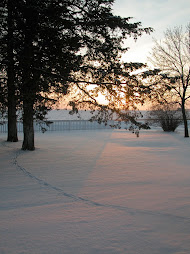
The old farmhouse has a checkered history. The land had once been home to Winnebago Indians, but the Torrens title makes no mention of that; the official record says only that the land was decreed by President Grant into the homestead of a man named Phillips, whose descendents still farm the thousand or so acres that stretch as far my gaze allows. The neighbor to the north, one of those descendents, told me recently that my house had once belonged to his grandfather. A neighbor who lives three farms to the south, meanwhile, told me she used to baby-sit for the family who lived here after Grandpa Phillips moved on. The house had changed a lot, she said. Indeed. I’ve been trying to piece together its history for three years now and all I’ve been able to muster is similar to what you get when you take a picture at noon on a sunny day – contrasting outlines devoid of fine detail.
Before I left home last week to attend to family commitments in the city, I closed the storm windows trying to hold on to late summer’s heat knowing autumn’s chill loomed close. On my return this morning, I was met with an inside temperature of 62 degrees F., hardly tolerable for the warm-blooded soul that I am. Fortunately, the chill was temporary, for today we made another entry into our family’s chapter of “farmhouse history.” Today, we added a wood stove to give us supplemental heat.
It made sense for us to supplement our furnace heat with wood heat because wood is so plentiful here; we chose to place the stove in the kitchen because it is the coldest room in the house, running about five degrees colder than the two story section of the main house.
In preparation for the installer’s arrival, hubby and I cleared out the upstairs hall closet where, at the back, there is hidden a small door that opens into the attic above the kitchen. Before this past week, we’d never really taken a serious look at the attic above the kitchen, so we were a bit concerned to open the door to find that the wall and roof boards near where the stove chimney would rise from the kitchen ceiling toward the outdoors was charred black. And I mean charred BLACK. There had once been a fire! Our farmhouse had had a fire!
With flashlight in hand, we tried to piece together the events that left part of our attic blackened. We wondered where the fire had started, how it hadn’t spread to consume the whole house, and why, for heaven’s sake, the charred boards had never been replaced! There were no answers for us up there. Like much of this farmhouse’s past, we have only conjecture and scant memories from distant neighbors. Oh well.
The wood stove went in on schedule and in it, a fire — a glorious warm fire for the last day of a warm September that departs with an undeniable chill. The temp in the kitchen, as I write this, is 75 degrees F. For now, we’ve forgotten about the fire that once crept up the wall into the attic. We’ll get back in there soon to replace the charred boards that should have been ditched long ago. Why they weren’t we’ll never know. That’s just how it goes with an old house with a mysterious past. Sometimes, you just never know what you’ve got — until you’ve got it.
30 September 2009


31 August 2009
There's romance in growing grapes
As our second growing season nears its natural end, I've developed a bit of pride over what's become of the scraggly old horse pasture. (I admit this knowing that pride can be a dangerous thing.) The stately vines were swaying in a gentle breeze as I walked the tidy rows today. Most of the trunks are woody by now, and the ones that aren't are browning nicely in preparation for what we all know is coming, like it or not: winter.
I wish I could capture on film the entire vineyard, end to end, but I'd need a wide-angle lens or a daring pilot with a steady hand and neither are within reach today. Viewed from the road, the layout of row upon row of vines set against those quaint out-buildings makes me smile. It's an image of home that conjures those old Rockwell images of a near-forgotten America. The low building is the newest on the property, built in 1940. Before it housed vineyard tools, it sheltered horses and before that, hogs. Behind that building to the left is the chicken house and the tall building to the right is a granary. They are well-cared-for structures; hubby's source of pride I'm sure.
 Neither building would have such character, though, if not for the 650 vines stretching to the road and then south, draped in fading sun. It is the vineyard that defines our home more than the lake or the garden or the lawn or even the grand Cedars. This is how this place, this home, has evolved for our family so new to country living.
A neighbor who lives two properties down and raises pigs, planted three-quarters of an acre of grapes last spring and today, on my walk down the road, I noticed another neighbor, living just to the south, has made good on his promise to till up his alfalfa in anticipation of an acre of grapes to go in next spring. Though, it appears he's tilled up more than one acre! Maybe he's thinking long range, working in plans to expand like we had before our hands were soiled by the reality of grape growing. We wish him well.
I was giving a friend directions to our place the other day and I almost told her, once she reached our road, that we were the first vineyard on the right. The first vineyard...
I believe there's a Rockwellian movement afoot on our stretch of country road.
I wish I could capture on film the entire vineyard, end to end, but I'd need a wide-angle lens or a daring pilot with a steady hand and neither are within reach today. Viewed from the road, the layout of row upon row of vines set against those quaint out-buildings makes me smile. It's an image of home that conjures those old Rockwell images of a near-forgotten America. The low building is the newest on the property, built in 1940. Before it housed vineyard tools, it sheltered horses and before that, hogs. Behind that building to the left is the chicken house and the tall building to the right is a granary. They are well-cared-for structures; hubby's source of pride I'm sure.
 Neither building would have such character, though, if not for the 650 vines stretching to the road and then south, draped in fading sun. It is the vineyard that defines our home more than the lake or the garden or the lawn or even the grand Cedars. This is how this place, this home, has evolved for our family so new to country living.
A neighbor who lives two properties down and raises pigs, planted three-quarters of an acre of grapes last spring and today, on my walk down the road, I noticed another neighbor, living just to the south, has made good on his promise to till up his alfalfa in anticipation of an acre of grapes to go in next spring. Though, it appears he's tilled up more than one acre! Maybe he's thinking long range, working in plans to expand like we had before our hands were soiled by the reality of grape growing. We wish him well.
I was giving a friend directions to our place the other day and I almost told her, once she reached our road, that we were the first vineyard on the right. The first vineyard...
I believe there's a Rockwellian movement afoot on our stretch of country road.
24 August 2009
An ancient grain with bright future...
Chef son and I mastered Gluten Free Kibbi Nayyi using both Quinoa (his choice) and Amaranth (my choice). Each substitute grain garnered us taste and texture virtually indistinguishable from the Bulghur or cracked wheat that is traditionally used in the dish. I now have gained confidence to try a Tahbouli Salad with Amaranth, which closely resembles Quinoa in taste, texture and nutrition. I like Amaranth better, though, because this weekend I learned it may be something I can cultivate myself here next summer. And who knows where that might lead?
Beyond the borders of the United States, Amaranth is used in interesting ways. In Mexico it is popped and mixed with a sugar solution to make a confection called alegria or happiness. Milled and roasted amaranth seed is used to create a traditional Mexican drink called atole. Peruvians use fermented amaranth seed to make chicha or beer. Amaranth can be cooked as a cereal, ground into flour, popped like popcorn, sprouted, or toasted. The seeds can be cooked with other whole grains, added to stir-fry or to soups and stews as a nutrient-dense thickening agent. Amaranth flour is used in making pastas and baked goods.
Amaranth seed is 15 percent to 18 percent protein and contains respectable amounts of lysine and methionine, two essential amino acids not frequently found in grains. It is high in fiber and contains calcium, iron, potassium, phosphorus, and vitamins A and C. The fiber content of Amaranth is three times that of wheat and its iron content is five times more than wheat. It contains two times more calcium than milk. Using Amaranth in combination with corn or brown rice (or wheat) results in a complete protein as high in food value as fish, red meat or poultry; great news for vegetarians.
The name Amaranth is Greek for "never-fading flower" and its flower is what caught my attention yesterday. My friend Diane has three stands of Amaranth growing in her field, though she grows it purely for ornamental value. Amaranth is a bushy plant that grows five to seven feet tall with broad leaves and a showy flower head of profuse burgundy plumes. Hers are quite striking in her voluptuous bouquets.
But what intrigues me the most about Amaranth is that it seems easy to grow and though the seeds it produces are tiny, each plant is capable of producing 40,000 to 60,000 of them. I just paid about five dollars for a 16-ounce package of whole grain Amaranth, and a 22-ounce package of Amaranth flour goes for about eight dollars. I’m not saying I’m ready to plow under all my grass to sow Amaranth, but I can do simple math. I think it’s time to do a bit more experimentation in the kitchen to see exactly how valuable Amaranth can become!
Beyond the borders of the United States, Amaranth is used in interesting ways. In Mexico it is popped and mixed with a sugar solution to make a confection called alegria or happiness. Milled and roasted amaranth seed is used to create a traditional Mexican drink called atole. Peruvians use fermented amaranth seed to make chicha or beer. Amaranth can be cooked as a cereal, ground into flour, popped like popcorn, sprouted, or toasted. The seeds can be cooked with other whole grains, added to stir-fry or to soups and stews as a nutrient-dense thickening agent. Amaranth flour is used in making pastas and baked goods.
Amaranth seed is 15 percent to 18 percent protein and contains respectable amounts of lysine and methionine, two essential amino acids not frequently found in grains. It is high in fiber and contains calcium, iron, potassium, phosphorus, and vitamins A and C. The fiber content of Amaranth is three times that of wheat and its iron content is five times more than wheat. It contains two times more calcium than milk. Using Amaranth in combination with corn or brown rice (or wheat) results in a complete protein as high in food value as fish, red meat or poultry; great news for vegetarians.
The name Amaranth is Greek for "never-fading flower" and its flower is what caught my attention yesterday. My friend Diane has three stands of Amaranth growing in her field, though she grows it purely for ornamental value. Amaranth is a bushy plant that grows five to seven feet tall with broad leaves and a showy flower head of profuse burgundy plumes. Hers are quite striking in her voluptuous bouquets.
But what intrigues me the most about Amaranth is that it seems easy to grow and though the seeds it produces are tiny, each plant is capable of producing 40,000 to 60,000 of them. I just paid about five dollars for a 16-ounce package of whole grain Amaranth, and a 22-ounce package of Amaranth flour goes for about eight dollars. I’m not saying I’m ready to plow under all my grass to sow Amaranth, but I can do simple math. I think it’s time to do a bit more experimentation in the kitchen to see exactly how valuable Amaranth can become!
Subscribe to:
Posts (Atom)