I knew last night's freeze was coming and so I pulled in the red and green tomatoes, most of the banana peppers and the full-size green peppers. I gave up my second planting of green beans and sugar snap peas to the cold because, frankly, we'd had our fill of those by Labor Day. And the herbs, well, I had already put forth respectable effort drying them; what's more, I had clipped a bouquet of basil a few weeks ago and the green stems have been holding their own in a vase of water (covered by vented plastic) on my windowsill. And the raspberries, well their first season ended as sweet filling for gluten-free tarts that were gobbled quickly.
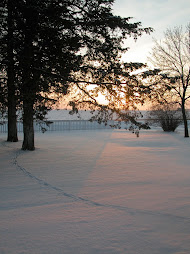
At dinner, Hubby and I enjoyed our last red tomatoes with fresh basil. It felt like just another light summertime meal if not for the roar of a hot fire warming our toes inside while outside the October sun cast long shadows over our now decimated garden. Ahh, autumn.
For those of us who appreciate farm-fresh local produce, we must now satiate ourselves with root vegetables such as squash, potatoes, carrots, onions, etc. Oh, and there's that sweet corn in the freezer! And the thirty-some quarts of fresh tomatoes that just went into canning jars. Of course, the local grocery has fresh asparagus, flown in from Peru. But how fresh can that really be because if I had just flown in from Peru, I don't think I'd be feeling very fresh. Autumn; it's a tough time of year for a locavore.
Last Sunday's New York Times magazine offers some interesting reading for foodies; it's their food issue. Included is this article by Michael Pollan titled "Rules to Eat By" with an interactive feature that includes twenty, reader-submitted dietary dos and donts. The list is varied and offers some gems worth pondering, such as "You don't get fat eating food you pray over."
Tomorrow, the forecast calls for snow. That alone is enough to send me in search of chocolate. But heck, we're only a few weeks into autumn. Ahh, autumn. I think I'll go sniff my vase full of basil while I still can.
09 October 2009


30 September 2009
Coming to expect the unexpected...
The old farmhouse has a checkered history. The land had once been home to Winnebago Indians, but the Torrens title makes no mention of that; the official record says only that the land was decreed by President Grant into the homestead of a man named Phillips, whose descendents still farm the thousand or so acres that stretch as far my gaze allows. The neighbor to the north, one of those descendents, told me recently that my house had once belonged to his grandfather. A neighbor who lives three farms to the south, meanwhile, told me she used to baby-sit for the family who lived here after Grandpa Phillips moved on. The house had changed a lot, she said. Indeed. I’ve been trying to piece together its history for three years now and all I’ve been able to muster is similar to what you get when you take a picture at noon on a sunny day – contrasting outlines devoid of fine detail.
Before I left home last week to attend to family commitments in the city, I closed the storm windows trying to hold on to late summer’s heat knowing autumn’s chill loomed close. On my return this morning, I was met with an inside temperature of 62 degrees F., hardly tolerable for the warm-blooded soul that I am. Fortunately, the chill was temporary, for today we made another entry into our family’s chapter of “farmhouse history.” Today, we added a wood stove to give us supplemental heat.
It made sense for us to supplement our furnace heat with wood heat because wood is so plentiful here; we chose to place the stove in the kitchen because it is the coldest room in the house, running about five degrees colder than the two story section of the main house.
In preparation for the installer’s arrival, hubby and I cleared out the upstairs hall closet where, at the back, there is hidden a small door that opens into the attic above the kitchen. Before this past week, we’d never really taken a serious look at the attic above the kitchen, so we were a bit concerned to open the door to find that the wall and roof boards near where the stove chimney would rise from the kitchen ceiling toward the outdoors was charred black. And I mean charred BLACK. There had once been a fire! Our farmhouse had had a fire!
With flashlight in hand, we tried to piece together the events that left part of our attic blackened. We wondered where the fire had started, how it hadn’t spread to consume the whole house, and why, for heaven’s sake, the charred boards had never been replaced! There were no answers for us up there. Like much of this farmhouse’s past, we have only conjecture and scant memories from distant neighbors. Oh well.
The wood stove went in on schedule and in it, a fire — a glorious warm fire for the last day of a warm September that departs with an undeniable chill. The temp in the kitchen, as I write this, is 75 degrees F. For now, we’ve forgotten about the fire that once crept up the wall into the attic. We’ll get back in there soon to replace the charred boards that should have been ditched long ago. Why they weren’t we’ll never know. That’s just how it goes with an old house with a mysterious past. Sometimes, you just never know what you’ve got — until you’ve got it.


31 August 2009
There's romance in growing grapes
As our second growing season nears its natural end, I've developed a bit of pride over what's become of the scraggly old horse pasture. (I admit this knowing that pride can be a dangerous thing.) The stately vines were swaying in a gentle breeze as I walked the tidy rows today. Most of the trunks are woody by now, and the ones that aren't are browning nicely in preparation for what we all know is coming, like it or not: winter.
I wish I could capture on film the entire vineyard, end to end, but I'd need a wide-angle lens or a daring pilot with a steady hand and neither are within reach today. Viewed from the road, the layout of row upon row of vines set against those quaint out-buildings makes me smile. It's an image of home that conjures those old Rockwell images of a near-forgotten America. The low building is the newest on the property, built in 1940. Before it housed vineyard tools, it sheltered horses and before that, hogs. Behind that building to the left is the chicken house and the tall building to the right is a granary. They are well-cared-for structures; hubby's source of pride I'm sure.
 Neither building would have such character, though, if not for the 650 vines stretching to the road and then south, draped in fading sun. It is the vineyard that defines our home more than the lake or the garden or the lawn or even the grand Cedars. This is how this place, this home, has evolved for our family so new to country living.
A neighbor who lives two properties down and raises pigs, planted three-quarters of an acre of grapes last spring and today, on my walk down the road, I noticed another neighbor, living just to the south, has made good on his promise to till up his alfalfa in anticipation of an acre of grapes to go in next spring. Though, it appears he's tilled up more than one acre! Maybe he's thinking long range, working in plans to expand like we had before our hands were soiled by the reality of grape growing. We wish him well.
I was giving a friend directions to our place the other day and I almost told her, once she reached our road, that we were the first vineyard on the right. The first vineyard...
I believe there's a Rockwellian movement afoot on our stretch of country road.
Subscribe to:
Posts (Atom)